

Learn & Explore/Habitats/Streams/Adaptation
Adaptation
Learn how Hawaiʻi’s native fish evolved to survive in fast-moving, waterfall-filled streams.
Adaptations of Hawaiian Freshwater Gobies
Hawaiian streams are wild, fast-moving, and constantly shifting — yet five native fish species have evolved to thrive in this tough environment.
The small number of freshwater fish in Hawai‘i shows how challenging it is to survive in these streams.
When we look closely, we can see specific adaptations that help each species survive and reproduce.
Adaptations are special traits or features that develop in a species to help them live successfully in a particular habitat.
These adaptations come from two evolutionary forces:
- Random genetic mutations — small changes in an animal’s DNA that create new physical traits.
- Natural selection — the environment “chooses” which traits help an animal survive and pass those traits on to future generations.
If a mutation helps the fish survive or reproduce, it’s more likely to be passed down. If not, it usually disappears over time.
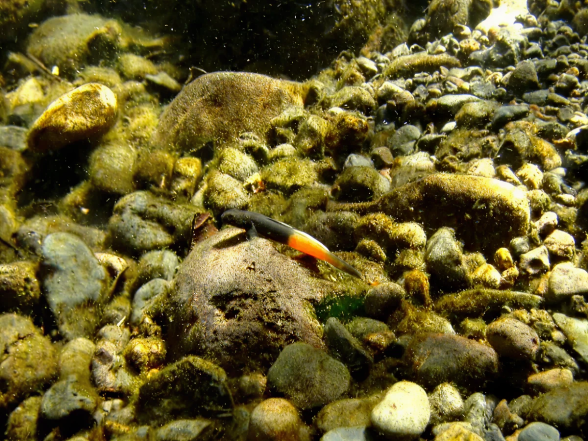
Amphidromous Migrations: A Key Adaptation
- All five species of Hawaiian freshwater fish share an important adaptation: amphidromous migration.
- Amphidromy is a life cycle that involves two migrations (usually one downstream and one upstream) not directly linked to reproduction.
- Right after hatching, larvae are washed into the ocean. They live in oceanic plankton for about three months, or up to six months for Sicyopterus stimpsoni (‘o‘opu nōpili).
- Large groups of larvae (hinana) return to streams, often after flash floods push freshwater far into the ocean.
- This life cycle is crucial for survival on oceanic islands, where streams are vulnerable to hurricanes, flash floods, and lava flows.
- Ocean-dwelling larvae act as a reservoir, allowing species to repopulate streams after catastrophic events.
- Ocean currents help disperse larvae to other streams and islands, maintaining genetic diversity and a complete gene pool.

Estuary Challenges and Upstream Migration
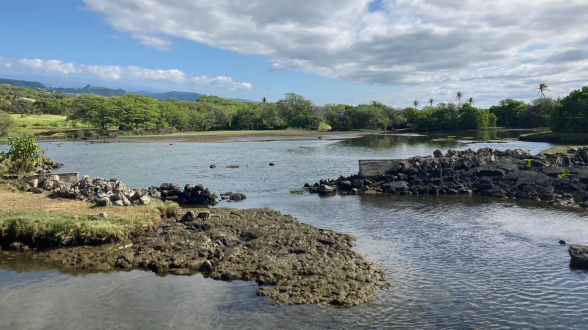
When returning to the estuary, larvae face a hostile environment, including pounding surf at the stream mouth.
Behavioral adaptations help them survive:
- Using wave action from incoming tides
- Actively swimming through the tidal zone
- A strong instinct to swim against the current, which ancient Hawaiians used to catch hinana with downstream-facing traps.
Once in the estuary, larvae are preyed upon by many marine and freshwater species.
Each species uses a different survival strategy:
- Eleotris sandwicensis and Stenogobius hawaiiensis: Stay in the estuary for life, Cannot climb waterfalls, so do not move upstream.
- Awaous guamensis, Lentipes concolor, and Sicyopterus stimpsoni: Move past the estuary, Adapted to climb waterfalls to reach adult habitats upstream.
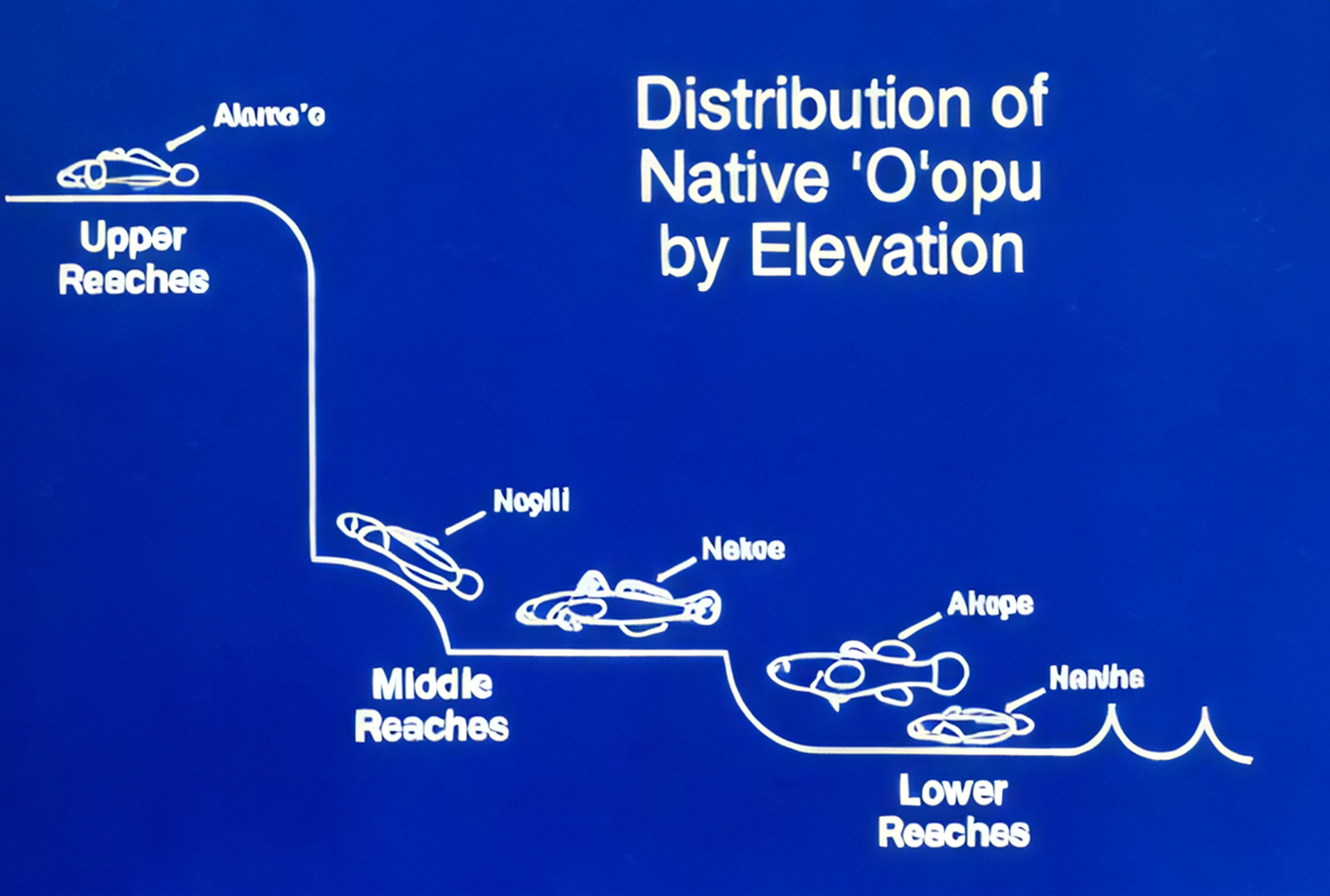
After the terminal waterfall, the three climbing species distribute along the stream based on climbing ability:
- Awaous guamensis → lower to mid-stream reaches
- Sicyopterus stimpsoni → mid-stream reaches
- Lentipes concolor → above even the highest waterfalls in Hawai‘i
Climbing Adaptations and Metamorphosis
On the way to adult habitats, Awaous guamensis and Lentipes concolor:
- Spend very little time in the estuary
- Climb the terminal waterfall immediately to escape predators
- Use their pelvic sucking disk to anchor to surfaces while swimming powerfully upward
- The pelvic sucking disk: Originally adapted for tidal zone survival; Acts as a pre-adaptation for climbing waterfalls; Remains useful in adult habitats to hold position on rocks.
Sicyopterus stimpsoni behaves differently:
- Remains in the estuary for about 36 hours before climbing
- Cannot climb using swimming and pelvic disk alone
- Undergoes a rapid and complete metamorphosis during this time, one of the most remarkable among vertebrates: Mouth shifts from front of head to ventral (underside); Upper lip grows and functions as a second sucking disk for climbing
- Once metamorphosis is complete, S. stimpsoni climbs by alternately attaching and releasing its pelvic disk and ventral mouth, inching up the waterfall safely
- In its adult habitat, the ventral mouth is perfect for scraping diatoms off rocks while holding on with the pelvic disk
Many more adaptations certainly exist in these fish in order to ensure their survival in Hawaiian freshwater streams. The few examples given here may illustrate the immense barriers that have prevented more species of fish to colonize the Hawaiian freshwater system.
Learn more about the O‘opu nōpili and the anatomy of its hinana (PDF)