

Learn & Explore/Species/Marine Mammals/Humpback Whale
Humpback Whale
Hawaiian name: Ka Koholā
Scientific name: Megaptera Novaeangliae
Description and Natural History
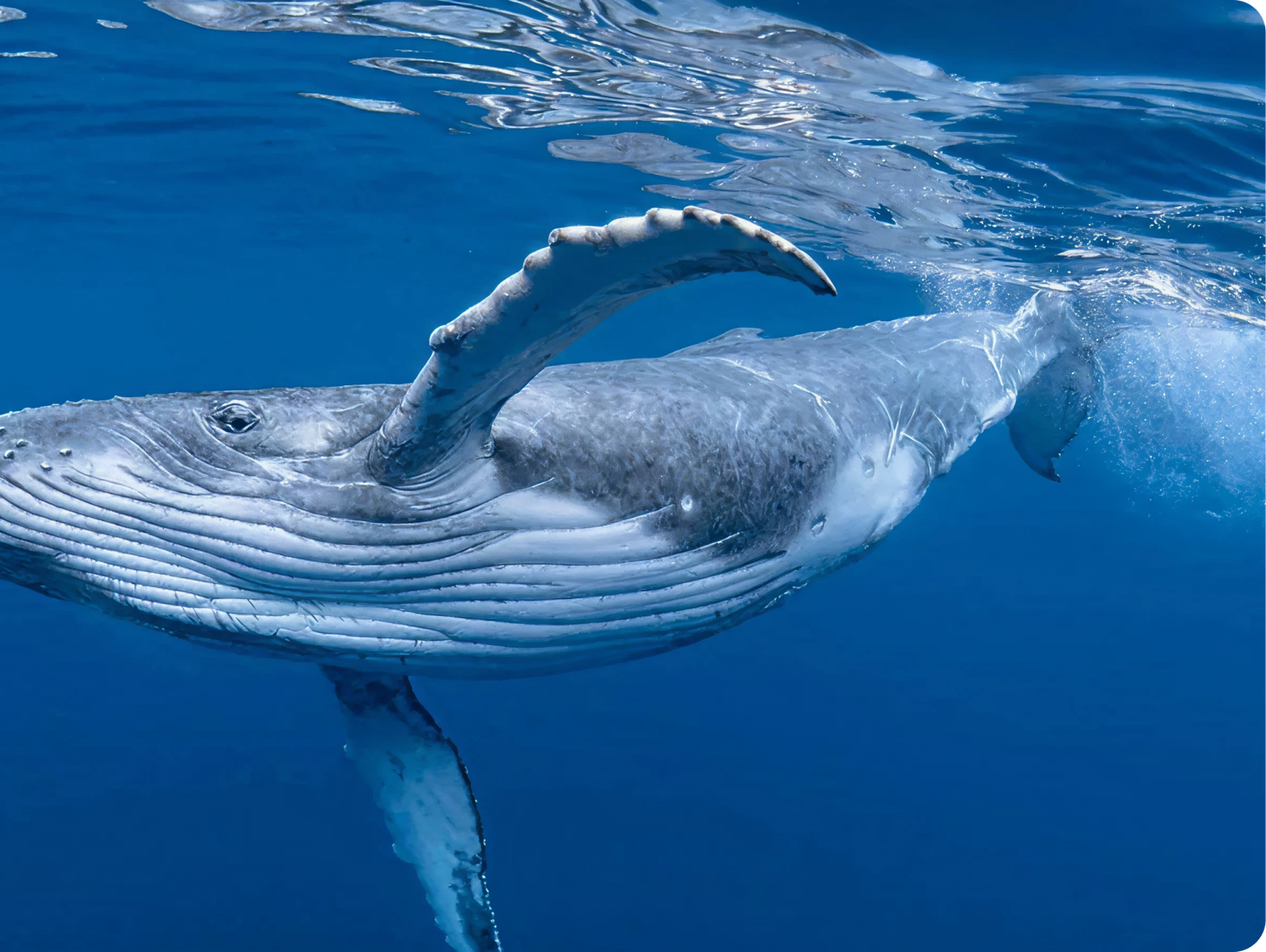
- Humpback whales (Megaptera novaeangliae) are the most common baleen whales in Hawaiian waters.
- They’re massive mammals, living up to 90 years, measuring 45–60 ft, and weighing around 66,000 lbs — basically the size of a school bus.
- These whales are found worldwide and grouped into 14 Distinct Population Segments (DPS), each genetically and geographically unique.
- The Hawai‘i DPS migrates 3,000 miles from Alaska and the Bering Sea to Hawai‘i every year to mate, give birth, and nurse calves in warm shallow waters.
- Before 2015, surveys estimated up to 10,000 humpbacks in the Hawai‘i DPS.
- In 2016, the number of returning whales dropped by at least half, with noticeably fewer calves.
- Three major ocean-warming events in 2016 — El Niño, Pacific Decadal Oscillation, and a marine heatwave — likely reduced food availability (krill and small fish), contributing to the decline.
- Although numbers have improved, HIHWNMS annual surveys suggest it’s still unclear if populations have fully recovered to pre-2016 levels.
The False Killer Whale
QUICK FACTS
LENGTH
Up to 60 feet
LIFESPAN
Up to 90 years
THREATS
Vessel Strikes, Vessel-Based Harassment, Entanglement
Status and Protection
Like all marine mammals, all humpback whale DPS are protected by the Marine Mammal Protection Act (MMPA). The global population of humpback whales was initially listed as endangered under the Endangered Species Act (ESA). However, after years of research, in 2016, NOAA’s National Marine Fisheries Service (NMFS) divided the species into 14 DPS, and delisted all but four. Two DPS that use US waters, Central America and Western North Pacific DPS, remain listed as endangered under the ESA, and one DPS in US waters (Mexico DPS) remains listed as threatened. There are other endangered DPS in foreign waters. The Hawai‘i DPS is not listed. The International Union for Conservation Nature (IUCN) lists the global population of humpbacks as least concern.
Diet and Habitat
- Humpback whales are filter feeders, eating mainly small fish and zooplankton like krill.
- While they’re in Hawai‘i, they barely eat because the waters are low in nutrients and don’t provide enough of their usual food.
- Instead, they survive by burning their stored body fat throughout their stay.
- Once the calves are strong enough, the whales migrate back to Alaska to feed again.
Reproduction
- The shallow waters around Maui County are ideal for humpback whales to mate, give birth, and nurse their young.
- Hawai‘i’s warm waters help newborn calves stay warm and safely avoid orca predators.
- These conditions allow calves to build the blubber they’ll need for Alaska’s cold waters.
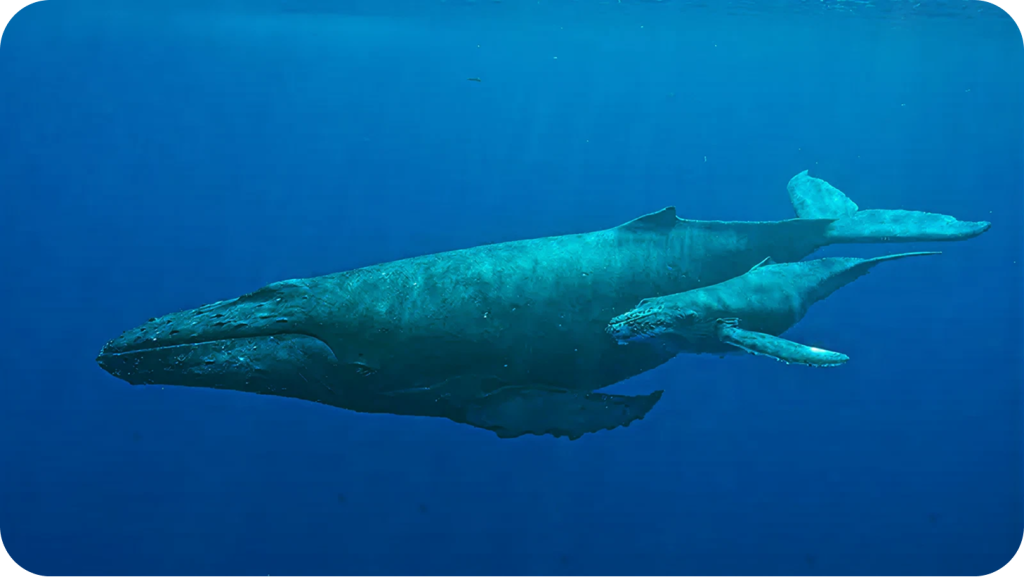
- Female humpbacks typically produce one calf every 2–3 years, though some give birth annually.
- Mothers stay very close to their calves during the first year and provide the rich, fatty milk the calves depend on.
Behavior
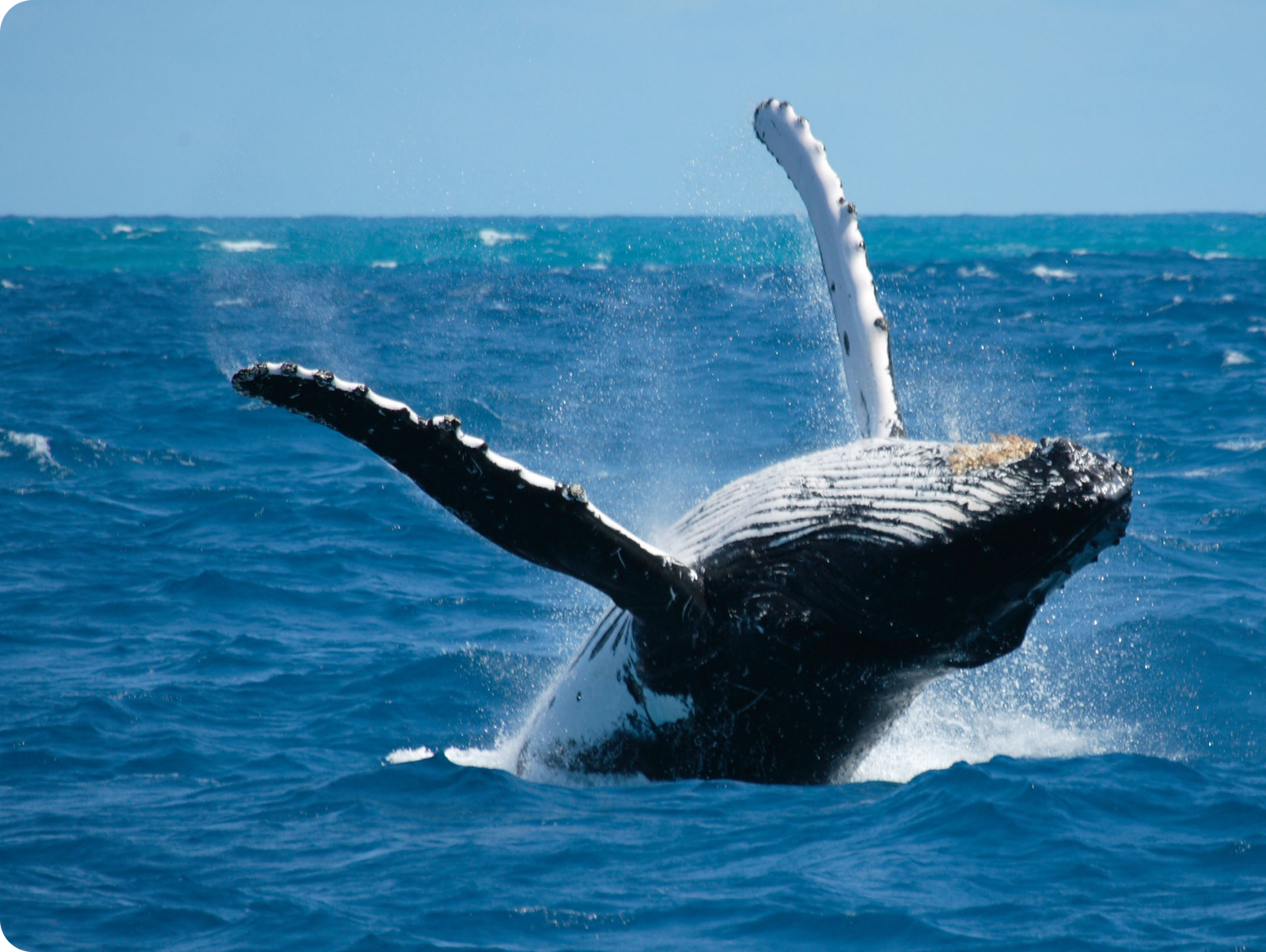
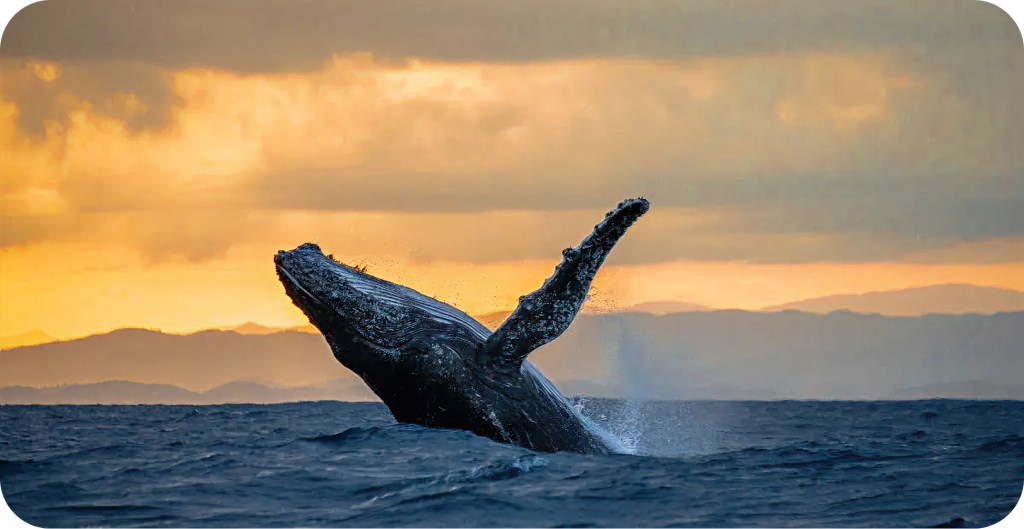
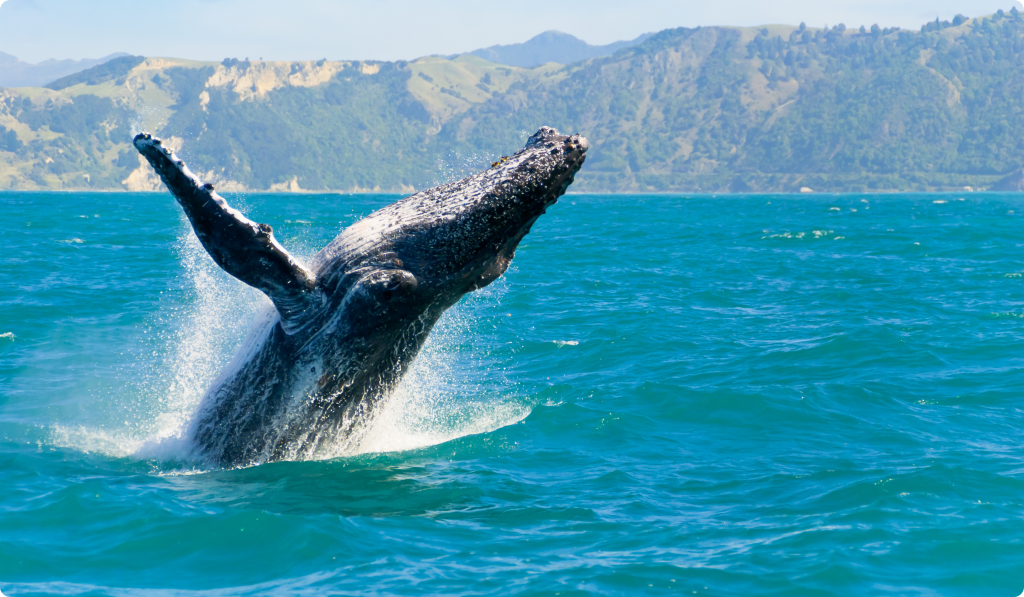
- Humpback whales are super active and acrobatic, especially in Hawaiian waters.
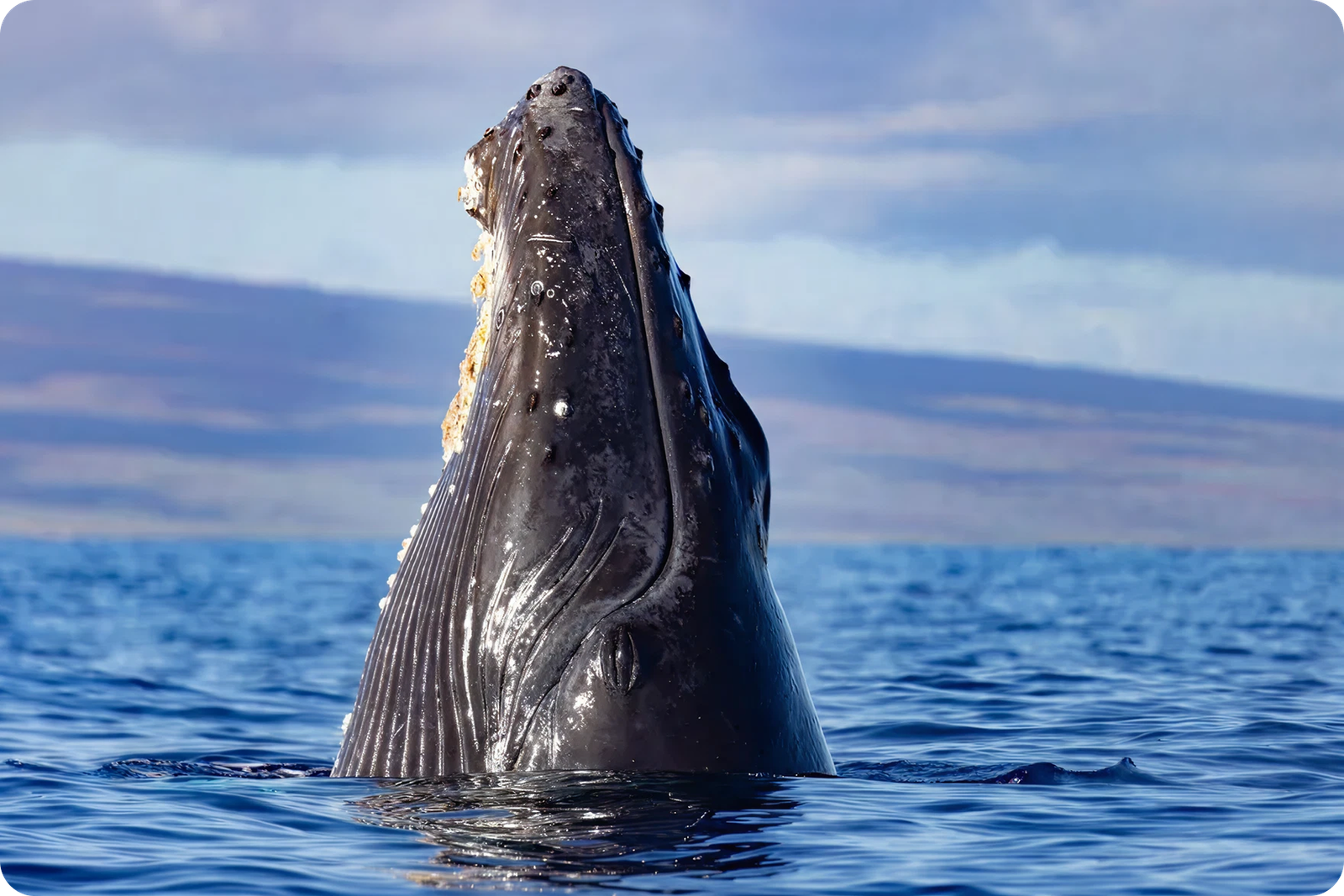
- During whale season, you can spot daily behaviors like: Breaching, Spy hopping, Tail slaps, Peduncle throws, Pectoral fin slaps
- Scientists haven’t locked down one exact reason for these moves, but they’re commonly linked to: Male competition, Protective behavior from mothers, Communication, Curiosity, Playfulness
Threats
- Even though the Hawai‘i DPS has made a strong comeback, humpback whales still face major human-related threats, including:
- Entanglement in marine debris
- Vessel strikes
- Environmental and climate-driven changes
Entanglement
- Ed Lyman of HIHWNMS leads the Pacific region’s Large Whale Entanglement Network and studies humpback entanglements with colleagues Maria Harvey and Rachel Finn.
- Their research shows that around 20% of humpback whales have scars from past entanglements.
- Every year, trained teams respond to whales tangled in: Fishing nets, Buoys, Crab pots, Boat moorings,Even undersea cables
- About two-thirds of entangled whales in Hawai‘i bring the gear from northern waters, while the rest get entangled locally.
- Entanglement can lead to starvation, drowning, or serious infections due to restricted movement.
Vessel Strikes
- Humpbacks are vulnerable to vessels everywhere they migrate, but the risk spikes in busy coastal zones.
- Hawai‘i relies heavily on ocean traffic, and although most vessels are small, whales—especially calves— are still struck every year.
- DLNR’s DAR & DOBAR, HIHWNMS, NOAA Fisheries, and Pacific Whale Foundation partnered with commercial tour operators to update best management practices (BMPs) aimed at:
- Reducing vessel strikes
- Protecting both people and whales
Humpback Whale Protection Guidelines
Best Management Practices Around Humpback Whales by NOAA Fisheries
Key Recommendations from the Recovery Plan
- Reduce or eliminate injury and mortality caused by fisheries, fishing gear, and vessel collisions
- Minimize effects of vessel disturbances
- Continue the international moratorium on commercial whaling
- Collect as much data as possible from dead whales through our Marine Mammal Health and Stranding Program
Recovery Efforts for Humpback Whales
- Creating marine protected areas for humpback whales
- Minimizing vessel disturbances
- Reducing entanglement in fishing gear
- Reducing vessel strikes
- Understanding and addressing the effects of ocean noise
- Collaborating with the Commission on Environmental Cooperation to develop the North America Humpback Whale Conservation Action Plan for the United States, Canada, and Mexico
Efforts to Reduce Whale-Watching Harassment
- Restrict approaching within 100 yards of a humpback whale
- Avoid placing your vessel in the path of oncoming humpback whales, causing them to surface within 100 yards of your vessel
- Not disrupting the normal behavior or prior activity of a humpback whale
- Operating your vessel at a slow, safe speed when near humpbacks
To report a violation of approach guidelines and regulations, call the NOAA Fisheries Enforcement Hotline: 800-853-1964.
Whale Safety Rules
IT’S THE LAW!
If you see a humpback, you and/or your vessel should stay more than 100 yards away for you and the marine animal’s protection.
To report a violation of approach guidelines and regulations, call the Enforcement Hotline: 800-853-1964 .
If you see an injured or entangled whale in Hawaiian waters please call the 24-hour NOAA Marine Wildlife hotline at 1-888-256-9840 (Option 3).
To learn more about the Hawaiian Islands Humpback Whale National Marine Sanctuary and Large Whale Entanglement Response program, click here.
Literature Cited
1. NOAA Fisheries. (2017, June). False killer whales: Sentinels of ocean health .
2. Baird, R.W., A.M. Gorgone, D.J. McSweeney, D.L. Webster, D.R. Salden, M.H. Deakos, A.D. Ligon, G.S. Schorr, J. Barlow and S.D. Mahaffy. 2008. False killer whales (Pseudorca crassidens) around the main Hawaiian Islands: long-term site fidelity, inter-island movements, and association patterns. Marine Mammal Science 24:591–612 .
3. Reeves, R. R., Leatherwood, S., & Baird, R. W. (2009). Evidence of a possible decline since 1989 in false killer whales (Pseudorca crassidens) around the main Hawaiian Islands. Pacific Science, 63(2), 253–261 .
4. Bradford, A. L., Forney, K. A., Oleson, E. M., & Barlow, J. (2017). Abundance estimates of cetaceans from a line-transect survey within the U.S. Hawaiian Islands exclusive economic zone. Fishery Bulletin, 115(2), 129–142 .
5. Baird, R.W., S.D. Mahaffy, A.M. Gorgone, K.A. Beach, T. Cullins, D.J. McSweeney, D.S. Verbeck and D.L. Webster. 2017. Updated evidence of interactions between false killer whales and fisheries around the main Hawaiian Islands: assessment of mouthline and dorsal fin injuries. Document PSRG-2017-16 submitted to the Pacific Scientific Review Group.
6. NOAA Fisheries. (2023, January). Sperm whale .
7. Olivera, Joylynn. 2001. The Cultural Significance of Whales in Hawai‘i. Hawaiian Islands Humpback Whale National Marine Sanctuary, Kīhei, HI. 4 pp.
8. Weinberg, Elizabeth. (2018, September). Humpback whales are navigating an ocean of change . Office of National Marine Sanctuaries.
9. US Department of Commerce, NOAA Fisheries. (2014, May). National marine sanctuaries. Hawaiian Islands Humpback Whale 2010 Condition Report .
10. Harvey, M., R. Finn, E. Lyman. Health and Risk Assessment Monitoring Program 2022–2023 Season-End Report. Hawaiian Islands Humpback Whale National Marine Sanctuary, Kīhei, HI. 21 pp.